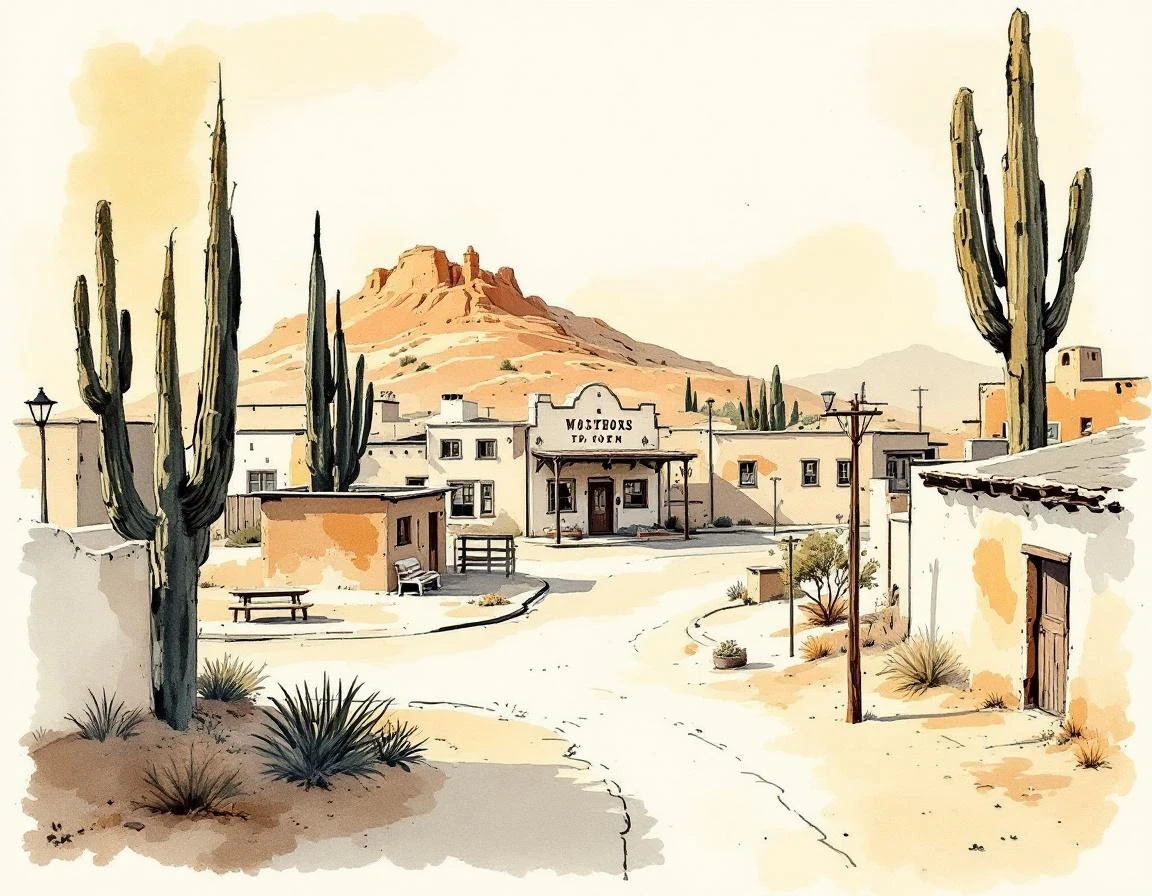
Southwestern American Town Naming Traditions
Spanish missionaries and colonial administrators left the most visible layer. Settlements named for saints (*San Antonio*, *Santa Fe*, *Los Angeles*) follow a pattern codified in the 1573 *Ordenanzas de Descubrimiento*, which instructed colonizers to name new towns for the feast day nearest the founding. The names were bureaucratic before they were poetic. Beneath that layer sit the older Indigenous names, many surviving in transliterated form. *Tucson* comes from the O'odham *Cuk Ṣon* ("base of the black hill"). *Taos* derives from the Tiwa *Tua-tah*. Anglo cartographers often mangled the phonology and stripped the meaning, leaving sounds without referents. The Anglo-American wave brought a different logic: boosterism and aspiration. Towns named *Goldfield*, *Bonanza*, or *Eureka* were advertisements as much as addresses, meant to attract settlers and investors. Others borrowed prestige from elsewhere - *Memphis*, *Carthage*, *Troy* - grafting Old World or Eastern associations onto desert scrub. These layers rarely sit cleanly. A single county might hold a Nahuatl river, a Spanish mission town, and a railroad stop named by a land speculator in 1887. The result is a naming record that doubles as a compressed history of who held power, who was erased, and what each wave of arrivals thought they were building.
Indigenous Foundations
Many Southwestern towns carry names from Navajo, Apache, Hopi, Zuni, and Pueblo languages. These names tend to describe the land itself, particular events, or tribal origins. *Tucson* comes from the O'odham *Cuk Ṣon*, meaning "at the base of the black hill." *Taos* comes from the Tiwa language of Taos Pueblo, where it referred to the village itself. The names are less ornamental than functional - they record how the region's first inhabitants read and named the world around them.
Spanish Colonial Influence
Spanish colonization from the 16th century onward left a distinct mark on the region's place names. Catholic saints gave their names to dozens of towns - San Antonio, Santa Fe, San Diego - while Las Cruces ("The Crosses") reflects the religious vocabulary that shaped how settlers understood and claimed the land. Descriptive Spanish terms for landscape followed the same logic: Mesa, Verde, Blanca, Rio. These weren't decorative choices; they were practical ones, orienting travelers through unfamiliar terrain. Compound names like El Paso ("the pass") work the same way, though Albuquerque is an outlier - named not for geography but for the Spanish Duke of Alburquerque, the viceroy of New Spain at the time of its founding.
Anglo-American Additions
Mining towns got practical names or wishful ones: Silver City, Tombstone, Phoenix (the last borrowed from mythology, a city built on the ashes of a Hohokam settlement). Railroad companies platted towns and named them after officials, eastern cities, or nowhere in particular. The result is a layered record: Spanish land-grant names under Anglo additions, Tohono O'odham place names anglicized beyond recognition, and railroad stops named for men nobody remembers.
Modern Southwestern Naming
Southwestern town names tend to reach for heritage, sometimes deliberately and sometimes out of habit. Planned communities often borrow Spanish-inflected names to signal regional belonging; a few draw on Diné or O'odham words to acknowledge who held the land first. The names that stick usually earn their place through specificity: a mesa formation, a particular range of the Rockies, a saguaro stand, a dry wash that floods twice a year. Generic names like Sunridge or Desert Vista could be anywhere in the Sun Belt and feel like it.
Southwestern American Town Names: A Working Naming Guide
Southwestern American town names should feel used, not arranged. Start with the ground: desert basins, mission plazas, mining camps, border crossings, mesas, pueblos, and interstate service towns. Then decide what sort of place is being named, because a mission town, border city, mining camp, reservation edge town, ranching settlement, or desert suburb asks for a different kind of word than a capital or a ruin. The generator can give you a quick spread, but the choice still has to sound like someone could say it while giving directions, filing a complaint, selling grain, dodging patrols, or pointing at a storm line. Keep a few candidates that disagree with each other. One may sound tired from use; another may feel like a mapmaker cleaned it up too much. That friction is useful.
Who Gets to Name the Place
Pick the naming authority before you fall in love with the syllables. Local speech keeps and loses names in ways officials rarely predict. A tax office wants tidy spelling. A priest wants a saint. A tribal office, elder, surveyor, rancher, railroad man, or company lawyer may all have a reason to push a different version. For Southwestern American town names, the useful candidate usually reveals who got to write the sign and who kept saying the older word anyway. Read the name in a sentence of dialogue. If every character would pronounce it the same way, the place may be too clean.
Language Care Before Style
Spanish, Pueblo, Navajo, Apache, O'odham, Anglo booster, and railroad names are not interchangeable. Some real names touch sacred places. This is where many generated names go wrong. They borrow surface sound while ignoring who owns the language, whether the place is real, and what history the word may touch. Fiction gives you room to invent, but it does not make every source available for casual decoration. If you need a real cultural reference, narrow it to a specific region and period. If you are making a secondary world, decide what parts of the naming logic you are adapting and what parts you are leaving alone.
The Work Inside the Name
The town needs work inside it. Maybe people came for a ferry, a mine, a shrine, pasture, a school, a harbor, a wall, or a road that cut through older country. Maybe they stayed because leaving cost too much. Let that practical reason roughen the name. A good result can hold an official story and a private one at the same time: the polished name on the station board, the clipped version in a market, the older name used at home, the insult outsiders keep repeating. That layered feel matters more than a rare letter combination.
The Scene Test
Before keeping a result, run it through a small scene. Put it on a weather report, in a grandmother's warning, on a border form, and in the mouth of someone who wants the place forgotten. For Southwestern American town names, the winner should make one concrete promise about geography, class, danger, faith, trade, or memory. It should also leave room for a writer to disagree with it later. Town names age. They get translated badly, painted over, shortened by children, revived by activists, sold by developers, or cursed by people who left. Choose the one that can survive that kind of handling.